
Scotch Plains City Directory Holdings
Scotch Plains does not have one proven, uninterrupted township-only directory run. The dependable starting points are regional collections that name Scotch Plains in their titles or holdings descriptions. The New Jersey State Library inventory identifies Wand’s Plainfield-area directory run from 1903 through 1916, while the National Archives directory holdings list Plainfield-area volumes for 1929–1930, 1931, and 1933 that include Scotch Plains. Check each edition. The stated span does not prove every year survives or that every edition has the same sections.
| Collection | Years | Where held | Access |
|---|---|---|---|
| Wand’s Plainfield-area city directories | 1903–1916 identified | Plainfield Public Library and State Library inventory | Name or address research; verify each edition |
| Digitized Plainfield-area directory | 1903 | Digifind-It | Online PDF; inspect the title, heading, and page |
| NARA Plainfield-area directories | 1929–1930, 1931, 1933 | National Archives holdings | Early-1930s person and address snapshots |
| SPFHS Culmen yearbooks | 1938, 1942, 1944–2006 | Scotch Plains and Fanwood library resources | Names, class context, photographs, and activities |
| Joint Digital Archives | Item-specific | Library and Fanwood local-history gateways | Digitized newspapers, books, and local ephemera |
The local-history shelf adds newspapers, yearbooks, maps, church and cemetery leads, rather than replacing these regional directory volumes. It is also the right fallback when a name is absent from one edition. Absence may reflect a skipped volume, a different municipality heading, an OCR error, or an unlisted household.
Scotch Plains Library City Directory Routes
The Scotch Plains Public Library genealogy resources bring together local reference help, yearbooks, newspapers, FamilySearch affiliate access, HeritageQuest, Fold3, and Ancestry Library Edition. Ancestry Library Edition is available inside the library, so it should not be treated as a home-access collection. FamilySearch affiliate access can expose images that a remote account only indexes. Record the collection title, event date, place, and image or film number before moving on.
Reference Solutions is another useful, licensed library route. Its U.S. Standard White Pages search can use a name, location, or phone number and can supply residential or business information according to the library’s current license. Preserve the search date and access condition. For older local work, a librarian can help identify the directory, yearbook, newspaper, cemetery, or local-history item that fits a particular name, street, and period.
The library’s history and research page is the source for this local-history image and its newspaper-database routes.
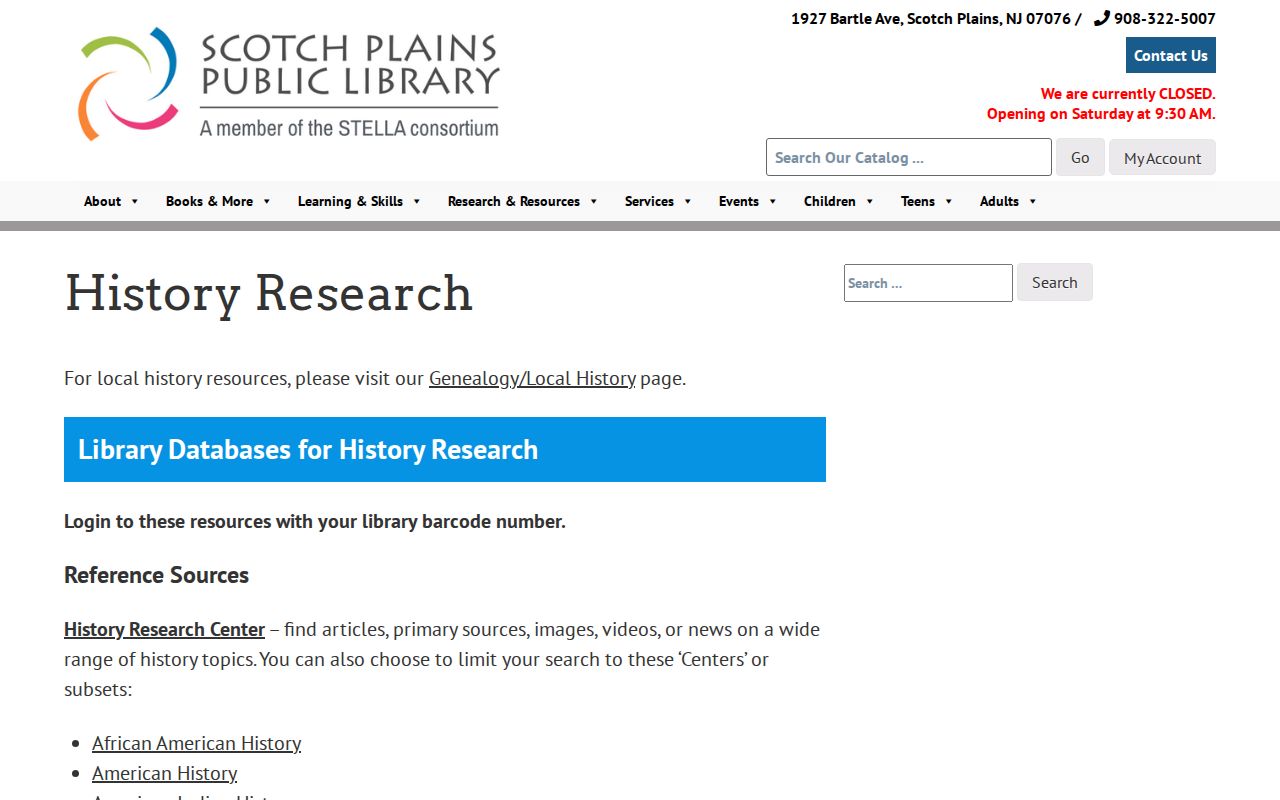
Regional newspapers can fill the time between directory editions, but their database coverage and OCR quality vary by title and issue.
Wand’s Scotch Plains City Directory Volumes
The title of Wand’s regional work is itself a search aid: it joins Plainfield, North Plainfield, Westfield, Mountainside, Dunellen, Fanwood, and Scotch Plains. The digitized 1903 volume is a real local-region artifact, but research did not establish a stable page number for a named Scotch Plains sample entry. Use the PDF visually, note the municipality heading, and capture the title page and entry page together. That recordkeeping step prevents a later reader from mistaking a regional heading for a township-only publication.
The later NARA holdings offer a separate early-1930s checkpoint. They can be especially useful when a household moved between census years. Neither group of records establishes a complete printed chronology. Where the needed year is missing, ask for a nearby edition, a reverse section, or a newspaper search instead of filling the gap with an assumption.
Note: Keep the edition year with every extracted entry, since a directory entry reports the publisher’s snapshot rather than a continuing residence.
Interpreting a Scotch Plains City Directory Entry
A city directory entry commonly compresses a great deal into one line. The Library of Congress describes U.S. directories that may arrange people by surname and include an address or telephone number, spouse notation, trade, an organization, or civic references. The exact marks depend on the publisher and edition. A name at a street address does not prove title ownership, and it does not establish current occupancy. Treat it as dated evidence that needs a second source.
| Page and heading | Page number plus the Scotch Plains or regional municipality heading |
|---|---|
| Name form | Surname, given name, initials, spelling variants, and suffixes as printed |
| Family notation | Spouse or widow notation, when the edition uses it |
| Trade or organization | Listed occupation, organizational reference, or abbreviation when present |
| Address detail | Street, house number, telephone, and residence-status mark only if printed |
| Volume evidence | Title, publisher, year, and the abbreviation key |
- Criss-cross directory
- An address-ordered section that reverses the usual lookup direction, letting a researcher begin with a street and number.
- Householder index
- A name list focused on the household representative, which can leave other residents out.
- Abbreviation key
- The volume’s explanation of its shortened words and marks. Photograph or transcribe it with the entry.
- Index versus image
- An index points to a result; the page image supplies the headings, formatting, and context needed to interpret it.
Scotch Plains City Directory Address Sections
For a person-to-place question, begin in the alphabetic name section. For a place-to-person question, ask whether the volume has a reverse or criss-cross section. The library’s public pages do not publish a complete year list for those address sections, so availability must be checked volume by volume. A reverse listing can suggest an occupant at a given number, but it still should not be read as a deed or as proof that every person in the home appears there.
Modern parcel and deed work belongs to the Scotch Plains Street Directory. The historical volume helps formulate the older name, street spelling, and date that make a current-record search more precise. Keep each form of an address separately: directory street wording, tax situs, legal description, and postal address can differ without any of them being wrong.
Tracing Scotch Plains City Directories for Families
A household trail is strongest when each edition is treated as a dated observation. Start with the surname and every printed initial, then write down the street, spouse or widow notation, trade, and nearby entries. A move is more credible when the same combination appears in the next available directory, a census, a newspaper notice, or a recorded land transaction. A disappearance has several possible causes: a move, death, omission, changed spelling, or a missing collection year.
- Find the surname in the first available Scotch Plains or Plainfield-area edition and retain the page, heading, year, and abbreviation key.
- Search the next available edition under each spelling, initial, and spouse name, noting street changes and neighboring entries.
- Check an address section when the volume has one, then preserve both the name-side and address-side evidence.
- Pair the dated directory finding with the 1910, 1920, 1930, 1940, or 1950 census as appropriate. The 1950 census is open; NARA’s 72-year release rule places the 1960 census opening in 2032.
- Use a deed, probate record, cemetery transcription, or well-sourced obituary to test a move or death rather than treating a directory notation as conclusive.
Newspaper notices help between decennial census years. Search an exact surname with Scotch Plains, Fanwood, and Plainfield, then add a street or spouse. Hyphens and initials can be misread by OCR. When a historic result needs modern corroboration, use a focused Scotch Plains resident lookup instead of assuming that an old listing identifies the same person today.
Scotch Plains Directory Clues in Yearbooks
The SPFHS Culmen run has volumes for 1938, 1942, and 1944 through 2006, with no 1943 volume noted. Earlier class pictures are also described. A yearbook can support a name, school era, photograph, club, or class connection. It is not a current-address record. If a person is absent in 1943, the collection gap matters more than the absence. Check adjacent volumes and other local sources before drawing a conclusion.
The Scotch Plains-Fanwood Historical Society is the source for this local-history image and offers a genealogical research-request route.
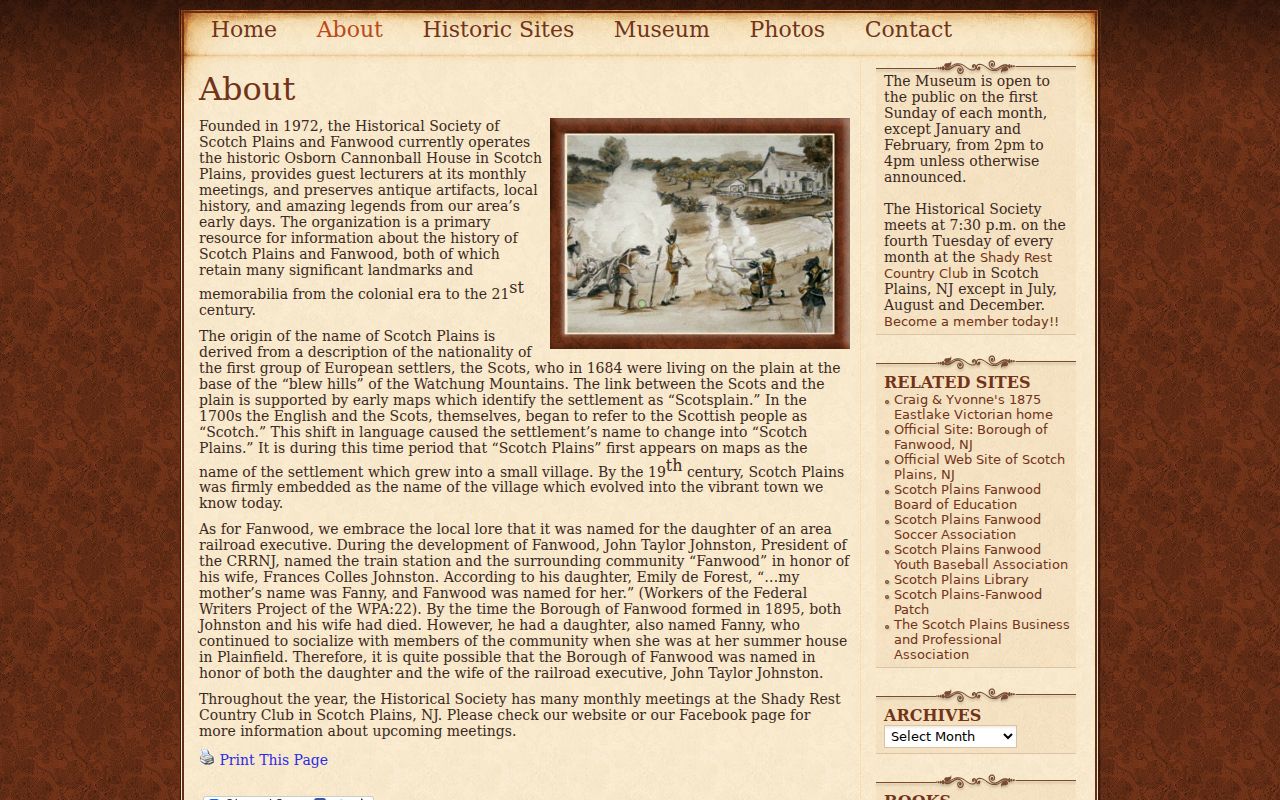
The society was founded in 1972 and operates the Osborn Cannonball House. Contact it before a research visit; its museum hours are listed as the first Sunday from 2 to 4, except January and February.
Scotch Plains Directory Name Variants
Older local material does not always file the township under a modern exact spelling. The Historical Society identifies Scotsplain as an early map spelling, while regional directories and newspapers may use Fanwood, Glenside Park, or Plainfield as a heading. Search those alternatives deliberately, then keep the source heading in the citation. Using a regional heading is not proof that the household lived in another municipality. It is a way to account for how the publisher organized the record.
Scotch Plains history reaches back to settlement in 1684 and a meetinghouse and cemetery in 1742. Church registers, cemetery material, newspapers, and deeds can extend a directory trail into those earlier layers. Historical maps add a building or street context, but they do not identify occupants without supporting directory or newspaper evidence.
Scotch Plains Directory Records Timeline
The following milestones describe known collections and access changes, not a complete publication history. No authoritative source located a courthouse fire, flood, or total loss event for Union County, so no such loss should be assumed when an entry cannot be found.
- 1857: Union County Clerk Record Room’s stated land-transaction floor, useful when a directory lead turns into a title question.
- 1903–1916: Wand’s Plainfield-area run identified by the State Library inventory.
- 1929–1933: NARA’s listed Plainfield-area directory snapshots, including Scotch Plains.
- 1938 onward: Culmen yearbook coverage begins, with the documented 1943 gap and later listed volumes through 2006.
- 2026: Library databases, local-history gateways, and affiliate access remain practical research channels whose availability should be checked at the time of use.
Note: Label every result with its directory edition, map year, newspaper date, or record-access date so later comparisons retain their proper time frame.